Dental Implants for Multiple Missing Teeth | Durham
Can Dental Implants Replace Multiple Missing Teeth? Yes, dental implants can replace multiple missing teeth. Depending on the number and location of the missing teeth, your dentist may recommend individual implants, an implant-supported bridge, or a full-arch restoration. You may not need one implant for every missing tooth. In many cases, strategically placed implants can support several replacement teeth. This can restore your ability to chew, improve the appearance of your smile, and provide greater stability than a removable appliance. At Modern Dental of Durham, we use advanced imaging and personalized treatment planning to determine which tooth-replacement option best fits your oral health, needs, and smile goals. How Do Dental Implants Replace Missing Teeth? A dental implant is a small post placed in the jawbone to support a replacement tooth or dental restoration. Once the implant has healed and integrated with the surrounding bone, it can act as a stable foundation for a crown, bridge, or full arch of teeth. According to the American Dental Association, custom-made bridges or dentures may be attached to dental implants when more than one tooth needs to be replaced. The right restoration depends on: How many teeth are missing Whether the missing teeth are next to each other The health of your gums The amount and quality of available jawbone The condition of your remaining teeth Your overall health and treatment goals A dental implant consultation allows your dentist to examine these factors and create a treatment plan specifically for you. Option 1: Individual Dental Implants When several teeth are missing in different areas of the mouth, individual dental implants may be recommended. Each missing tooth is replaced with its own implant and customized crown. Because the implants stand independently, the surrounding natural teeth usually do not need to be reshaped to support the restoration. Each crown can also be designed to match the size, shape, and color of your natural teeth. However, individual implants are not always necessary when multiple missing teeth are located next to one another. Option 2: An Implant-Supported Bridge An implant-supported bridge can replace several adjacent missing teeth without placing an implant beneath every replacement tooth. For example, two implants may be positioned to support a bridge containing multiple artificial teeth. The implants act as anchors at each end, while the connected replacement teeth fill the space between them. Unlike a traditional dental bridge, an implant-supported bridge does not rely on neighboring natural teeth for support. The American Academy of Periodontology identifies multiple-tooth dental implants as an option for replacing several missing teeth. An implant-supported bridge may offer: A secure, stable fit Improved chewing function A natural-looking smile Support without modifying healthy neighboring teeth Greater comfort than some removable partial dentures Your dentist will determine how many implants are needed based on the size of the gap, the location of the missing teeth, your bite, and the condition of your jawbone. Option 3: Full-Arch Dental Implants When most or all teeth in the upper or lower jaw are missing or cannot be restored, a full-arch dental implant solution may be considered. With treatments such as All-on-4 dental implants, a complete arch of replacement teeth is supported by four or more strategically placed implants. This means an entire row of teeth may be restored without placing an implant for every tooth. Full-arch restorations are designed to remain securely supported by the implants. They may offer more stability for eating and speaking than traditional removable dentures. However, All-on-4 is not the right solution for every patient. A complete examination and detailed imaging are needed to evaluate your bone structure, gums, bite, and remaining teeth. What Are the Benefits of Replacing Multiple Teeth With Implants? Dental implants are designed to function as stable anchors for replacement teeth. For qualified patients, they can provide several practical and cosmetic benefits. Improved stability Implant-supported restorations are anchored in the jaw rather than resting only on the gums. This can provide better stability while speaking and chewing. Natural-looking results Crowns and bridges attached to implants can be customized to complement your remaining teeth and facial features. Support for healthy neighboring teeth An implant-supported bridge generally does not require healthy adjacent teeth to serve as anchors, unlike some traditional bridges. A fixed tooth-replacement option Depending on the restoration selected, implants can support replacement teeth that remain securely in place instead of being removed each day. Help maintaining the jawbone Because implants are placed within the jaw, they stimulate the surrounding bone during normal use. This may help reduce the bone loss that commonly occurs after teeth are lost. Do You Need One Implant for Every Missing Tooth? Not necessarily. One implant is commonly used to replace one missing tooth, but multiple adjacent teeth may be replaced with an implant-supported bridge. A full arch may also be supported by a limited number of strategically placed implants. There is no single implant number that works for everyone. Your dentist must consider the location of the missing teeth, the forces created by your bite, available bone, and the type of final restoration. The goal is to create a treatment plan that provides appropriate support, function, and long-term stability for your smile. Are You a Candidate for Multiple-Tooth Dental Implants? You may be a candidate when you: Have one or more missing teeth Have healthy gums or are willing to treat existing gum disease Have enough jawbone to support implants or qualify for bone grafting Are in suitable overall health for implant treatment Do not smoke or are prepared to follow your dentist’s recommendations Can maintain consistent brushing, flossing, and professional dental care Having experienced bone loss does not automatically rule out dental implants. Additional procedures, such as bone grafting, may help some patients become candidates. Only an in-person examination can determine whether implants are appropriate for you. What Happens During the Dental Implant Process? The process begins with a consultation and examination. Your dentist will evaluate your teeth and gums, review your health history, and use dental imaging to
Can a Cracked Tooth Heal on Its Own? Durham Dentist
A cracked tooth can happen when you least expect it. You might bite down on something hard, notice pain while chewing, or suddenly develop sensitivity to hot and cold foods. Can a cracked tooth heal on its own? Unfortunately, a true crack in a tooth cannot naturally repair itself. While the discomfort may come and go, the damage can remain and potentially worsen over time. Getting the tooth evaluated early can help protect it, prevent further damage, and determine the right treatment. Why Can’t a Cracked Tooth Heal Itself? Your teeth are incredibly strong, but they don’t heal the same way your bones or skin do. Enamel, the hard outer layer of your tooth, does not contain living cells capable of rebuilding a true crack. Once the tooth structure has fractured, it cannot simply grow back together. Sometimes the pain may disappear temporarily, but that doesn’t necessarily mean the crack has healed. The tooth may still be vulnerable to further damage or infection. What Causes a Tooth to Crack? Teeth can crack for several reasons, including: Biting down on hard foods, ice, or objects Grinding or clenching your teeth Large or older dental fillings that weaken the remaining tooth structure Trauma or an injury to the mouth Sudden changes in temperature Normal wear and tear over time In some cases, you may not even know exactly when the crack happened. What Does a Cracked Tooth Feel Like? Not every cracked tooth causes constant pain. In fact, symptoms can be surprisingly inconsistent. You may notice: Pain when biting down or releasing your bite Sensitivity to hot or cold temperatures Discomfort when eating sweet foods Pain that seems to come and go Tenderness or discomfort around the affected tooth Because these symptoms can also occur with cavities, damaged fillings, and other dental problems, a dental examination is important for determining what’s actually causing the discomfort. Are All Tooth Cracks Serious? No. The severity depends on the type, depth, and location of the crack. According to the American Association of Endodontists, cracked teeth can take several different forms, ranging from superficial craze lines to more significant cracks and split teeth. Learn more from the American Association of Endodontists Craze Lines These are tiny cracks that affect only the enamel. They’re common in adults and usually don’t cause pain. In many cases, treatment isn’t necessary unless there is a cosmetic concern. Fractured Cusp Part of the chewing surface of the tooth may break or weaken, often around a filling. Depending on the damage, your dentist may recommend a filling or dental crown to restore and protect the tooth. Cracked Tooth A crack can extend from the chewing surface toward the root. Early treatment is important because the crack may continue to spread and affect more of the tooth. Split Tooth If a crack progresses far enough, the tooth can separate into distinct sections. At this stage, saving the entire tooth may no longer be possible. What Happens If You Ignore a Cracked Tooth? A small crack can become a much larger dental problem. Continued chewing pressure may cause the crack to spread deeper into the tooth. If bacteria reach the inner pulp, the tooth can become inflamed or infected. At that point, treatment may become more extensive and could include root canal therapy, a dental crown, or, in severe cases, extraction. This is why waiting for a cracked tooth to “heal” can potentially make the situation worse. Even if the pain temporarily disappears, the underlying damage may still be present. How Does a Dentist Treat a Cracked Tooth? Treatment depends on the location and severity of the crack and how much of the tooth has been affected. Minor damage may only need monitoring or dental bonding. A larger crack may require a dental crown to strengthen and protect the remaining tooth structure. If the crack has reached the pulp inside the tooth, root canal treatment may be necessary before the tooth is restored. If the tooth is severely split or the crack extends into an area that cannot be predictably restored, extraction may sometimes be recommended. The goal is to preserve as much of your natural tooth as possible whenever it can be successfully restored. What Should You Do If You Think You Cracked a Tooth? If you suspect that you’ve cracked a tooth, avoid chewing hard or crunchy foods on the affected side until you can see your dentist. Don’t repeatedly test the tooth by biting down to see whether it still hurts. Additional pressure could potentially worsen the damage. Most importantly, don’t wait for the tooth to repair itself. The earlier a crack is diagnosed, the more treatment options may be available to protect the tooth and prevent further complications. Get Your Cracked Tooth Checked at Modern Dental of Durham A cracked tooth won’t naturally grow back together, but timely dental care may help prevent the crack from becoming a much bigger problem. If you’re experiencing pain when chewing, temperature sensitivity, or think you may have damaged a tooth, Modern Dental of Durham can evaluate the problem and recommend the appropriate treatment based on your needs. Don’t wait for a small crack to become a bigger dental problem. Schedule an appointment with Modern Dental of Durham today.
Dental Implant: Can You Get One Years After Losing a Tooth?
A dental implant is often the best long-term solution for replacing a missing tooth. Many patients worry they’ve waited too long after tooth loss, but in many cases, a dental implant may still be possible years later. The good news? Even if you’ve been missing a tooth for several years, you may still be a candidate for a dental implant. Is It Ever Too Late for a Dental Implant? In many cases, no. Dental implants can often be placed years—even decades—after a tooth has been lost. The biggest factor isn’t how long ago the tooth was lost. It’s the health of the jawbone that supports the implant. When a tooth is missing, the bone in that area no longer receives stimulation from chewing. Over time, the jawbone can begin to shrink, a process known as bone resorption. That’s why a dental evaluation is important before implant treatment. What Happens Before a Dental Implant After Tooth Loss? After losing a tooth, several changes can occur: The jawbone may gradually shrink over time. Nearby teeth can begin to shift into the empty space. Your bite may become misaligned. Changes in bone structure can affect facial appearance. Additional wear may occur on surrounding teeth. The longer a tooth is missing, the more likely these changes are to happen. However, they don’t automatically rule out dental implants. Can You Get a Dental Implant If You’ve Lost Bone? Possibly, yes. Modern dentistry offers several solutions for patients who have experienced bone loss, including: Bone grafting procedures Advanced implant planning with 3D imaging Strategic implant placement techniques A CBCT scan allows your dentist to evaluate bone volume and determine whether additional treatment is needed before implant placement. Are You a Candidate for a Dental Implant? The best way to find out is through a comprehensive dental examination. Your dentist will evaluate: Bone density and volume Gum health Overall oral health Medical history The location of the missing tooth Every patient is different, which is why a personalized treatment plan is important. Why Replacing a Missing Tooth Matters Many people adapt to living with a missing tooth, but leaving the space untreated can contribute to: Ongoing bone loss Shifting teeth Bite problems Difficulty chewing Additional dental complications in the future Replacing a missing tooth can help restore function, comfort, and confidence in your smile. The Bottom Line If you’ve been missing a tooth for years, don’t assume you’ve missed your chance for a dental implant. Advances in dental technology and treatment options have helped many patients restore their smiles long after tooth loss. The first step is finding out what’s possible for your specific situation. Ready to Explore Your Options? At Modern Dental of Durham, we use advanced imaging and personalized treatment planning to help patients determine whether dental implants are the right solution for their needs. Learn more about our Dental Implant services. Schedule your consultation today:Modern Dental of Durham Appointment Request
The Best Age for Invisalign Treatment
The Best Age for Invisalign Treatment A straight, confident smile is something people of all ages desire, and Invisalign treatment has become one of the most popular solutions for achieving it. Unlike traditional braces, Invisalign aligners are clear, removable, and comfortable, making them a great choice for a variety of patients. But when is the best age for Invisalign treatment? At Modern Dental of Durham, we’re here to help you determine the ideal time to begin your smile transformation. Invisalign for Teens (Ages 12-18) For many patients, the teen years are the perfect time to start Invisalign treatment. By this age, most or all of the permanent teeth have erupted, and the jaw is still growing, making it easier to guide teeth into their ideal positions. Benefits of Invisalign for teens include: ✔ Discreet Treatment – Clear aligners are nearly invisible, boosting confidence during school and social activities. ✔ Removable Convenience – Teens can take out aligners to eat, brush, and floss, promoting better oral hygiene. ✔ Effective for Mild to Moderate Issues – Invisalign can correct gaps, crowding, and bite issues effectively. Invisalign Treatment for Young Adults (Ages 18-30) Many young adults choose Invisalign to achieve a perfect smile while maintaining a professional appearance. This age group benefits from: ✔ Increased Responsibility – Young adults are more likely to wear aligners as directed. ✔ Flexibility – No dietary restrictions like with metal braces. ✔ Confidence Boost – A straighter smile can enhance self-esteem in personal and professional settings. Invisalign Treatment for Adults (30+) It’s never too late for a smile transformation! Many adults seek Invisalign Treatment for a variety of reasons, including: ✔ Improving Smile Aesthetics – Straight teeth contribute to a more youthful look. ✔ Correcting Shifting Teeth – Teeth can shift with age, and Invisalign helps realign them. ✔ Better Oral Health – Properly aligned teeth are easier to clean, reducing the risk of cavities and gum disease. When Should You Start Invisalign Treatment? The best age for Invisalign depends on individual needs, dental health, and lifestyle, however the younger the better! But regardless of age, Modern Dental of Durham will assess your teeth and create a customized Invisalign plan to fit your smile goals. Ready to Begin Your Invisalign Journey? If you’re considering Invisalign, schedule a consultation with Modern Dental of Durham today! We’ll help you achieve a healthier, straighter smile, at any age. 📞 Call us at 919-5443723 or visit https://www.moderndentalofdurham.com/request-an-appointment
Restore Your Smile with Dental Implants
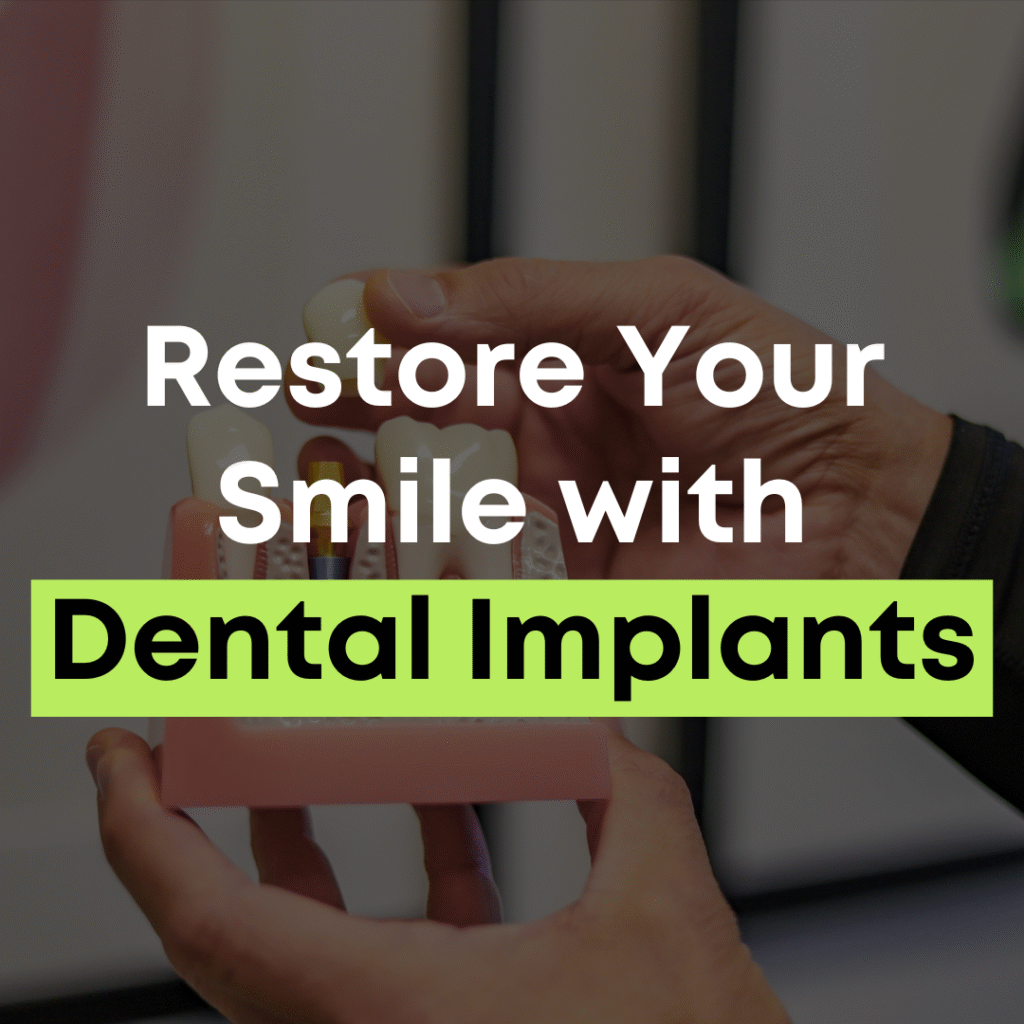
Restore Your Smile with Dental Implants Want to restore your smile? A healthy, beautiful smile is essential for confidence and overall well-being. If you’re missing one or more teeth, dental implants offer a permanent, natural-looking solution. At Modern Dental of Durham, we specialize in restoring smiles with high-quality dental implants that look, feel, and function like real teeth. What Are Dental Implants? Dental implants are artificial tooth roots made of biocompatible titanium, surgically placed into the jawbone to support a replacement tooth or bridge. Over time, the implant fuses with the bone, creating a strong and durable foundation for a crown, bridge, or denture. Benefits of Using Dental Implants to Restore Your Smile ✔ Natural Appearance – Implants mimic the look and feel of natural teeth. ✔ Durability – With proper care, implants can last a lifetime. ✔ Improved Oral Health – Unlike dentures, implants help preserve jawbone density and prevent bone loss. ✔ Better Functionality – Enjoy eating, speaking, and smiling with confidence. ✔ Convenience – No need for adhesives or nightly removal like traditional dentures. The Dental Implant Process Consultation & Evaluation – Our dental experts will assess your oral health and determine if implants are the right choice for you. Implant Placement – A small titanium post is surgically inserted into the jawbone. Healing & Osseointegration – Over a few months, the implant bonds with the bone. Crown Placement – A custom-made crown is attached to restore your smile’s appearance and function. Who Is a Good Candidate for Dental Implants? Most healthy adults with sufficient jawbone density and good oral hygiene are candidates for dental implants. If bone loss has occurred, a bone graft may be recommended to create a stable foundation for the implant. Why Choose Modern Dental of Durham to Restore Your Smile? At Modern Dental of Durham, we use the latest technology and advanced techniques to ensure precise placement, comfort, and long-lasting results. Our experienced team is dedicated to personalized care, helping you achieve the smile you deserve. Schedule Your Consultation and Restore Your Smile Today! Don’t let missing teeth hold you back. Schedule a consultation with Modern Dental of Durham today and take the first step toward a restored, confident smile. 📞 Call us at 919-544-3723 or visit https://www.moderndentalofdurham.com/dental-implants to learn more.
Dental Implant Myths Debunked
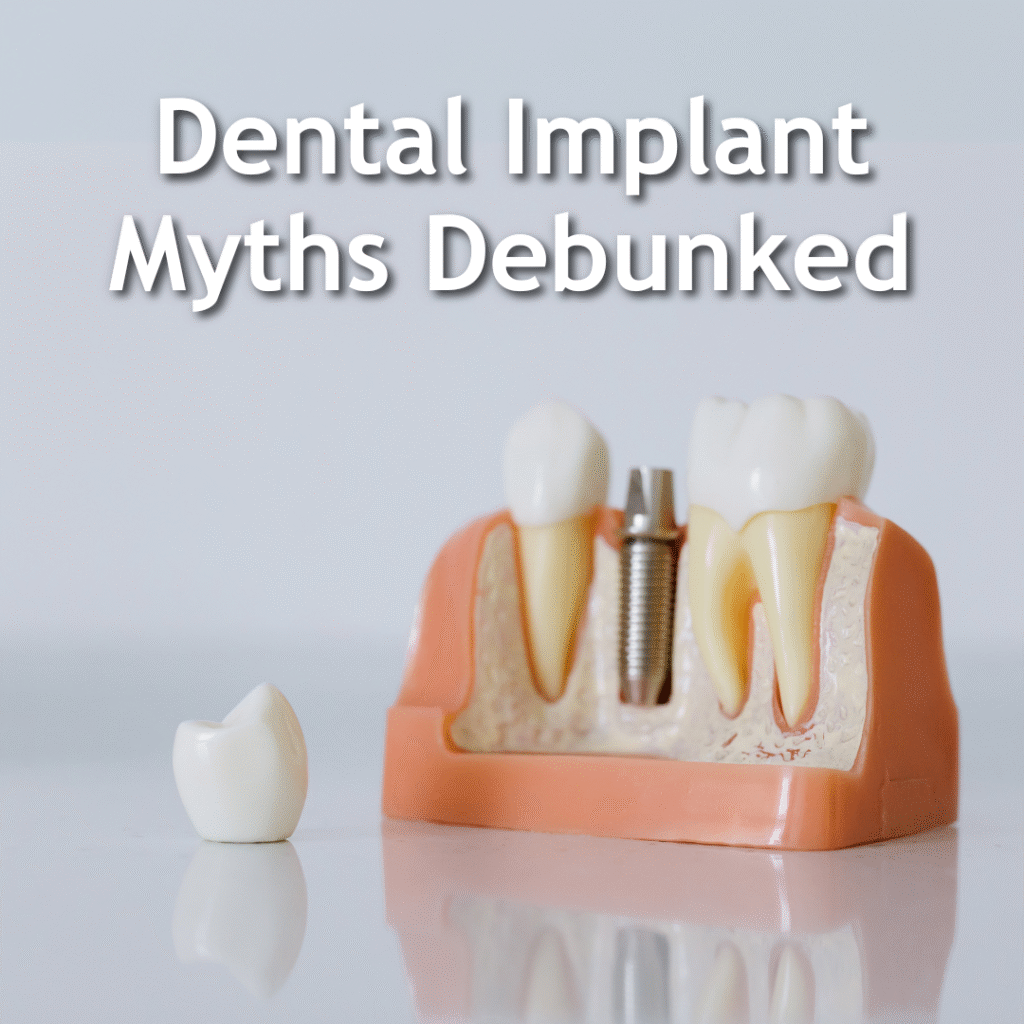
Dental Implant Myths Debunked Dental Implant Myths Debunked: Separating Fact from Fiction Thinking about replacing missing teeth with dental implants? You’ve likely come across a lot of conflicting information. Let’s clear the air. Here are some of the most common dental implant myths, along with the evidence to set the record straight. Myth 1: Dental Implants Are Painful Reality: The procedure is typically comfortable and well-managed with anesthesia or sedation. Most patients report minimal discomfort post-procedure, often less than what’s experienced with a tooth extraction. Recovery is usually quick and manageable with standard pain medication. Myth 2: Dental Implants Are Too Expensive Reality: While there’s a higher upfront cost compared to bridges or dentures, dental implants are a long-term investment. They can last a lifetime with proper care, while other options may require replacement or additional maintenance over time. Many practices offer flexible payment plans to ease the financial burden. Myth 3: Implants Look Fake or Unnatural Reality: Thanks to modern materials and precise cosmetic techniques, implants can be customized to match the shade, shape, and translucency of your natural teeth, making them virtually indistinguishable. Myth 4: Only Older Adults Can Get Dental Implants Reality: Age alone doesn’t determine eligibility. What matters most is jawbone health and overall wellness. Adults of all ages, whether in their 20s, 40s, or 60s, can be excellent candidates as long as they have adequate bone support and good oral health. Myth 5: Dental Implants Require Special Maintenance Reality: Caring for implants is just like caring for natural teeth: brush twice a day, floss daily, and keep up with regular dental check-ups. There’s no need for special cleaning solutions or tools. Myth 6: Dental Implants Have Low Success Rates Reality: Success rates for dental implants are exceptionally high, often above 95% when placed by experienced professionals using modern techniques. Long-term studies confirm their durability and reliability over many years. Why It Matters Don’t let myths hold you back from exploring a life-changing solution. Dental implants not only restore your smile, they support jawbone health, improve chewing ability, and boost confidence. Informed decisions lead to better outcomes. Want to Take the Next Step? Discover whether dental implants are the right option for you. Request your appointment today and schedule a personalized consultation with Modern Dental of Durham:👉 Request an Appointment