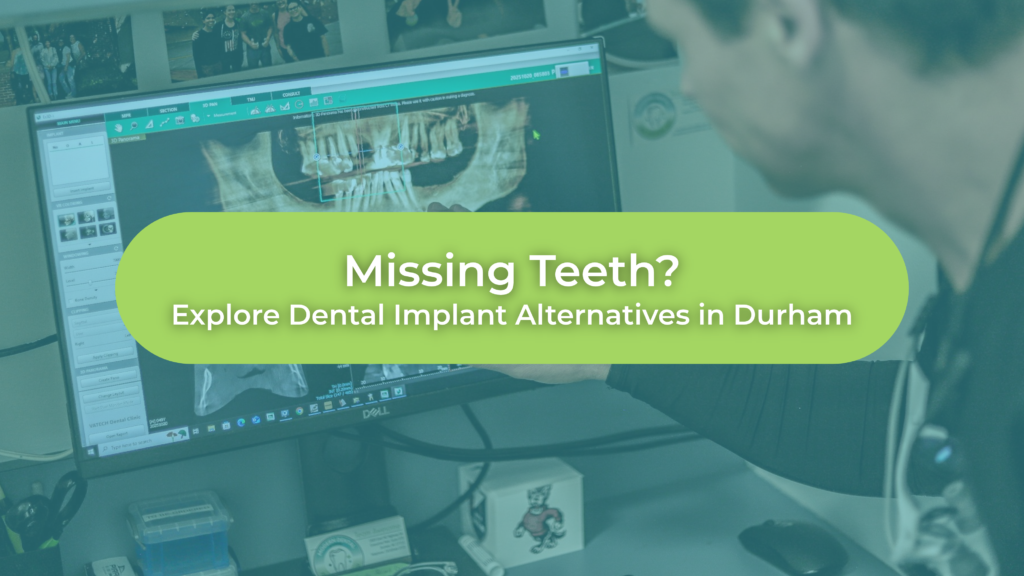
Missing Teeth? Explore Dental Implant Alternatives in Durham
Missing teeth can make everyday moments uncomfortable, from chewing your favorite foods to smiling in photos. You may want to close the gap but feel unsure about dental implants, especially when considering surgery, treatment time, or your budget. Dental implants are one option for replacing missing teeth. Depending on your oral health and the number of teeth missing, a dental bridge, removable partial denture, or full denture may also be worth discussing. Exploring dental implant alternatives in Durham starts with understanding how each option works and what would suit your smile. Dental Bridges: A Fixed Option for Missing Teeth A dental bridge fills a gap with artificial teeth supported by nearby teeth. A conventional tooth-supported bridge stays in place, so you do not remove it for daily cleaning. The American Dental Association’s MouthHealthy explains that bridges replace missing teeth and use surrounding teeth for support. A fixed bridge can only be removed by a dentist. A tooth-supported bridge may be an option when you want a fixed replacement without an implant. Your dentist will need to assess the teeth around the gap to determine whether they can provide suitable support. Questions to ask include: Are the teeth beside the gap healthy enough to support a bridge? How would those teeth need to be prepared? How should I clean around and underneath the replacement tooth? Removable Partial Dentures: Replacing Some Missing Teeth A removable partial denture replaces missing teeth while allowing you to keep your remaining natural teeth. It can be taken out for cleaning, and some designs attach to existing teeth. The National Health Service (NHS) explains that partial dentures can replace one or more missing teeth, while complete dentures replace all the teeth in the upper or lower jaw. Dentures can help with eating and speaking difficulties caused by tooth loss. A partial denture is an option to discuss when you have several gaps or prefer a removable replacement. Ask your dentist how it would fit, how to care for it, and what to expect as you adjust. Full Dentures: Replacing an Entire Row of Teeth When all the teeth in an upper or lower arch are missing, conventional full dentures may be considered. These removable appliances fit over the gums and replace an entire row of teeth without dental implants. Getting used to dentures takes time. The NHS notes that eating and speaking may initially feel different and that dentures need regular cleaning and ongoing dental checks. During your consultation, discuss comfort, stability, maintenance, and any adjustments that may be needed. Understanding these practical details can help you decide whether removable dentures fit your daily routine. How to Choose Between Dental Implant Alternatives The right replacement depends on more than how a treatment looks. Your dentist will consider the location of the gaps, the condition of your remaining teeth and gums, and your overall oral health. Bring these priorities to your appointment: Fixed or removable: Would you prefer a replacement that stays in place or one you remove for cleaning? Daily care: What cleaning routine can you comfortably maintain? Budget: What is the estimated total cost, and what does your insurance cover? Treatment process: How many appointments are needed, and will you need a temporary replacement? Long-term maintenance: What adjustments, repairs, or replacements might be needed over time? A dental exam helps turn these questions into a treatment plan that reflects your needs. Explore Your Tooth Replacement Options in Durham You do not need to have a treatment picked out before making an appointment. Start with your concerns, whether that is difficulty chewing, an uncomfortable gap, or uncertainty about dental implants. At Modern Dental of Durham, discuss your missing teeth and ask which replacement options may be appropriate for your oral health, preferences, and budget. Take the next step toward a more comfortable smile. Request an appointment at Modern Dental of Durham to explore your tooth replacement options.
Dental Implant: Can You Get One Years After Losing a Tooth?
A dental implant is often the best long-term solution for replacing a missing tooth. Many patients worry they’ve waited too long after tooth loss, but in many cases, a dental implant may still be possible years later. The good news? Even if you’ve been missing a tooth for several years, you may still be a candidate for a dental implant. Is It Ever Too Late for a Dental Implant? In many cases, no. Dental implants can often be placed years—even decades—after a tooth has been lost. The biggest factor isn’t how long ago the tooth was lost. It’s the health of the jawbone that supports the implant. When a tooth is missing, the bone in that area no longer receives stimulation from chewing. Over time, the jawbone can begin to shrink, a process known as bone resorption. That’s why a dental evaluation is important before implant treatment. What Happens Before a Dental Implant After Tooth Loss? After losing a tooth, several changes can occur: The jawbone may gradually shrink over time. Nearby teeth can begin to shift into the empty space. Your bite may become misaligned. Changes in bone structure can affect facial appearance. Additional wear may occur on surrounding teeth. The longer a tooth is missing, the more likely these changes are to happen. However, they don’t automatically rule out dental implants. Can You Get a Dental Implant If You’ve Lost Bone? Possibly, yes. Modern dentistry offers several solutions for patients who have experienced bone loss, including: Bone grafting procedures Advanced implant planning with 3D imaging Strategic implant placement techniques A CBCT scan allows your dentist to evaluate bone volume and determine whether additional treatment is needed before implant placement. Are You a Candidate for a Dental Implant? The best way to find out is through a comprehensive dental examination. Your dentist will evaluate: Bone density and volume Gum health Overall oral health Medical history The location of the missing tooth Every patient is different, which is why a personalized treatment plan is important. Why Replacing a Missing Tooth Matters Many people adapt to living with a missing tooth, but leaving the space untreated can contribute to: Ongoing bone loss Shifting teeth Bite problems Difficulty chewing Additional dental complications in the future Replacing a missing tooth can help restore function, comfort, and confidence in your smile. The Bottom Line If you’ve been missing a tooth for years, don’t assume you’ve missed your chance for a dental implant. Advances in dental technology and treatment options have helped many patients restore their smiles long after tooth loss. The first step is finding out what’s possible for your specific situation. Ready to Explore Your Options? At Modern Dental of Durham, we use advanced imaging and personalized treatment planning to help patients determine whether dental implants are the right solution for their needs. Learn more about our Dental Implant services. Schedule your consultation today:Modern Dental of Durham Appointment Request